
Diagnose. Find. Interrogate. Target.
The method uses four clear stages. It starts with organisational readiness and operational problems, then filters opportunities and defines the strongest candidates.
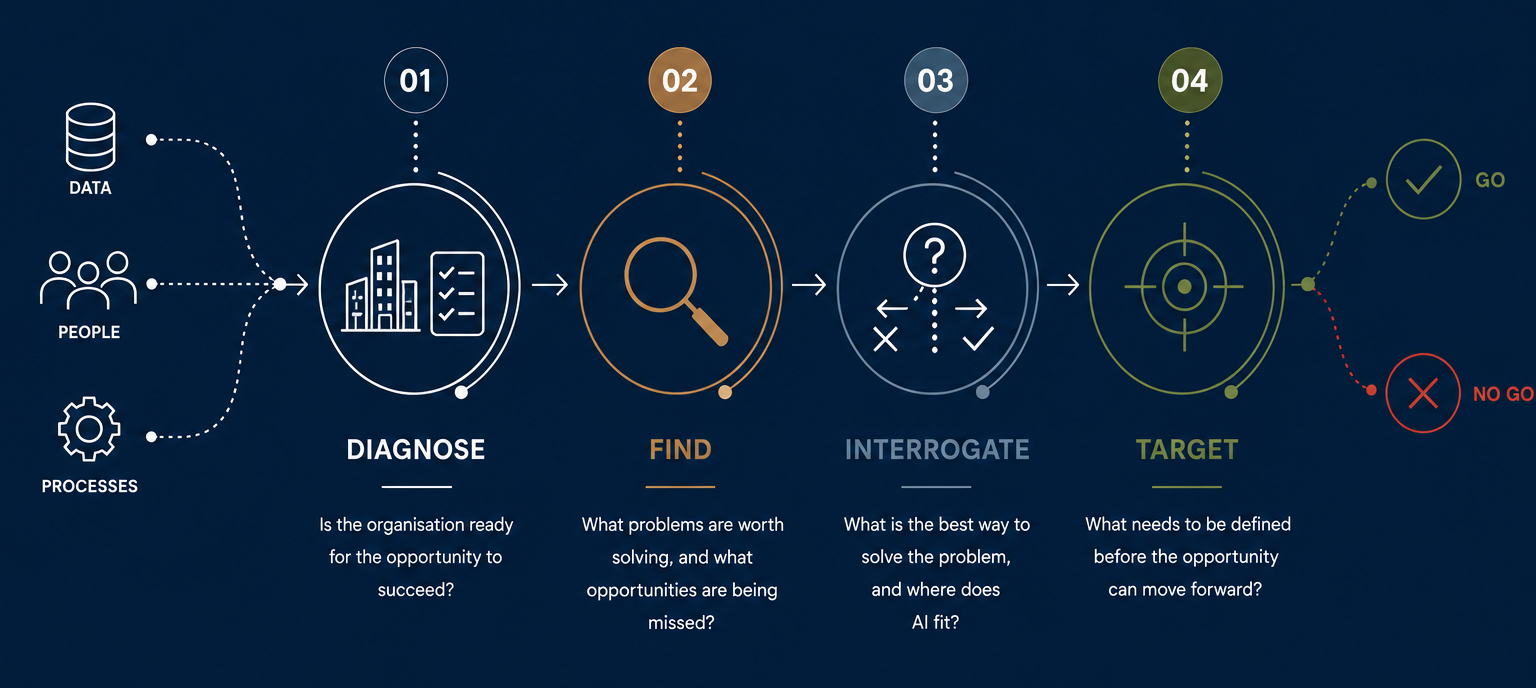
Four phases, each answering a different question.
Can the organisation support meaningful change?
Set the sponsor, scope and success criteria. Then test whether the organisation can absorb the change and identify the conditions that could affect delivery.
Sponsorship · decision discipline · process clarity · change capacity · data accessibility

Where is the real operational problem?
Look at how work is actually done instead of asking teams to invent AI ideas. Identify friction, exceptions and measurable business problems.
Observe actual work · expose exceptions · anchor value · map the real process
Does this problem really justify AI?
Challenge every candidate before it can become a recommendation. Does it create material value? Is it really AI? Build or buy? Is it sufficiently defined? Is the organisation ready? Are there relevant risks or regulatory concerns?
Value · AI fit · build or buy · definition · readiness · risk

What must be defined before it can move forward?
For each initiative that survives, produce a specification that supports estimation, design and an investment decision.
Business value · requirements · production integration · governance · adoption · sequencing
Problem-first. Engineering-led. Independent.
Problem-first
Starts with operational problems and desired outcomes, not with technology.
Engineering-led
Rooted in Requirements Engineering, Software Engineering and experience with real systems in production.
Independent
Has no requirement that the conclusion be “build”. It can recommend buy, simplify, postpone, redefine or reject.
Decision-oriented
Produces explicit decisions, not merely a catalogue of opportunities.
Business-value driven
The purpose is not to produce AI demonstrations. It is to identify initiatives that justify the effort and resources they require.
Production-aware
A technically successful PoC can still be a poor business investment if adoption, readiness or operational value are weak.
The recommendation comes before the implementation.
Right Problem separates the decision about what should move forward from the decision to implement it. The outcome may be to build, buy, simplify, defer, redefine or stop, depending on what the problem actually requires.
Not every opportunity should have the same destination.
Right Problem records a clear outcome for every opportunity. Strong candidates continue; weak, premature or misdirected ones stop consuming resources.
The opportunity survives interrogation and is ready to move forward.
Do not proceed under current conditions.
The problem is real, but AI is not the right response.
The capability is needed, but a mature market solution is the better path.
The economics do not justify the effort and resources required.
The problem is not sufficiently defined to justify moving forward.
Regulatory or legal concerns are included in the interrogation where relevant. Regulatory screening within the method is not formal legal advice.
Three outputs. One purpose: better decisions.
Organisational Readiness
Understand whether the organisation can absorb the change and which conditions may affect success.
Kill List + Prioritisation
Know what should proceed and what should be rejected, simplified, bought, postponed or reframed, with a clear reason for each decision.
Specification
Define the strongest opportunity well enough to support estimation, design and an investment decision.
Clients are not paying for documents. They are paying to know where to commit budget, people and management attention, and where not to waste them.